Sustainable Nursery & Sleep
A Parent’s Guide to Choosing an Organic Crib Mattress
A crib mattress is a small purchase with a big job: it must fit the crib correctly, provide a firm, flat sleep surface, and stand up to everyday care. Organic labels may help families understand how certain materials are produced, but they are only one part of a practical decision. Here’s how to weigh fit, construction, certifications, maintenance, and long-term impact without losing sight of safe sleep.
Published October 23, 2026
Start with the sleep surface, not the label
For a new parent, the crib-mattress aisle can feel like a test in materials science. Product pages may emphasize organic cotton, wool, latex, plant-derived foam, low emissions, or the absence of selected chemicals. Those details can matter to families choosing a lower-impact nursery. But the first questions are more basic: Is the mattress intended for this crib? Does it fit snugly? Is its sleep surface firm and flat? Can you follow the care and safe-sleep instructions?
Those checks are more consequential than a premium-sounding material name. Current safe-sleep guidance from the American Academy of Pediatrics recommends placing babies on their backs on a firm, flat, non-inclined surface designed for infant sleep, with only a fitted sheet. The mattress should meet applicable safety standards and be used according to the crib and mattress manufacturers’ instructions. A mattress marketed as organic does not replace those requirements.
That distinction is worth keeping in view throughout the search. “Organic” describes aspects of how a material is grown or processed under a particular standard; it does not, by itself, establish that a product is appropriate for an infant, safer in every respect, or compatible with a particular crib. Evaluate the whole product, then use certification as one piece of evidence about its materials and production.
Fit is a safety check, not a finishing detail
A well-made mattress cannot do its job if it does not fit the crib it will be used in. Before ordering, identify the crib’s model and the mattress size it requires. Check both sets of instructions, especially if the crib is older, convertible, or has a nonstandard interior dimension. A label that says “crib size” is not a substitute for confirming compatibility with the actual sleep space.
After assembly, place the mattress in the crib and check the fit around the entire perimeter. It should lie flat, without bowing or curling at the edges, and should not leave a hazardous gap between the mattress and crib sides. The U.S. Consumer Product Safety Commission advises checking crib-mattress fit; its commonly cited “two-finger test” is a screening check, not a reason to ignore manufacturer specifications. If the mattress shifts substantially, leaves a gap, or does not sit securely, stop using that combination and contact the crib or mattress manufacturer for guidance.
Fit can change if a mattress is moved between cribs, turned in a way the maker does not permit, or used with a different model. It can also become less dependable if the mattress is damaged, warped, or has a cover that no longer stays secure. Keep the purchase documentation and model information; they make it easier to confirm compatibility, find care instructions, and check for safety notices or recalls.
- Confirm the mattress dimensions and approved crib use before purchase.
- Follow the crib maker’s guidance on mattress thickness and support-board settings.
- Check that the mattress lies flat and fits securely on all sides.
- Recheck condition and fit after moving the mattress or adjusting the crib.
Firm, flat, and free of extra layers
For an infant, a sleep surface should be firm and flat—not plush, pillow-like, or shaped to cradle the baby. A surface that feels comfortable to an adult may be too soft for an infant’s sleep environment. If you are unsure whether a mattress is firm enough, consult its manufacturer and pediatric care provider rather than relying on a showroom impression or an informal home test.
Keep the crib clear of pillows, quilts, comforters, loose blankets, stuffed toys, positioners, and other soft objects. Do not add a topper or improvised padding to change the feel of the mattress. Use a fitted sheet made for the mattress, and follow the instructions for any product intended to protect it. A mattress protector or pad should not be added unless it is specifically designed for the crib mattress, fits securely, and is permitted by the mattress and crib makers. If the instructions are unclear, ask the manufacturer before use.
There is a practical reason for this simplicity: caregivers need a sleep space that is easy to inspect and arrange consistently. A mattress may have a removable cover or an appealing natural-fiber layer, but extra accessories can alter the surface, fit poorly, or introduce loose material. The safest setup is not the one with the most features. It is one that follows current guidance, matches the equipment instructions, and remains uncomplicated.
Read the construction, layer by layer
“Natural” and “organic” are broad words. To compare crib mattress materials, look for a clear description of what is in the core, what forms the outer cover, and how those layers are joined. A useful product specification identifies the main materials rather than relying on vague phrases such as “eco-friendly comfort.” If a maker does not explain the construction, ask for the information before buying.
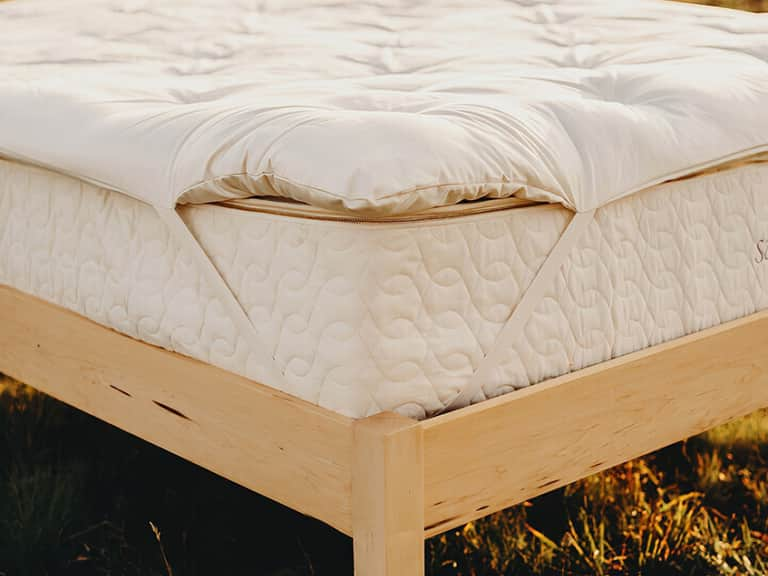
Some mattresses use cotton in a cover or batting; others use wool, latex, foam, or a combination of materials. Each has its own feel, weight, care requirements, and manufacturing footprint. Natural fibers are not automatically easy to clean, and synthetic components are not automatically unsuitable. The relevant questions are whether the finished mattress is intended for infant sleep, whether it meets applicable requirements, how durable it is, and how the maker says it should be cared for.
Pay attention to the full bill of materials. A description might identify the cover but leave the core unspecified, or describe a component as “plant-based” without stating how much of the finished material comes from plant sources. Ask whether layers are removable, whether the product is designed to be flipped, and whether turning or rotating is allowed. Do not assume a two-sided mattress should be reversed for an infant; follow the age-specific instructions printed by the manufacturer.
Construction details also inform maintenance. A tightly secured cover may be designed for surface cleaning, while a removable cover may have specific washing limits. Washing or soaking a mattress contrary to instructions can damage the materials, alter the fit, or compromise its structure. Clear construction information should be paired with clear guidance about what to do after a spill, how to dry the product, and when it should no longer be used.
What certifications can—and cannot—tell you
Certifications can make complicated supply-chain claims easier to assess, but each one applies to a defined scope. Look for the certification name, the organization behind it, and the exact product or component covered. A certification may apply to textile fibers, a processing facility, emissions, or a product category; these are not interchangeable claims.
For example, the Global Organic Textile Standard (GOTS) covers organic fibers and sets requirements across textile processing and manufacturing within its scope. A GOTS claim should be verifiable and clearly tied to the product or textile component being described. It does not establish that every part of a mattress—including its core, frame compatibility, or infant-use design—is certified. Nor does a textile certification substitute for checking that the mattress meets relevant product safety requirements.
Other certifications may address chemical content, emissions, or responsible sourcing. Read their scope rather than treating a logo as a universal seal of safety or sustainability. If a product page makes broad claims but gives no certificate number, certifying organization, or explanation of what was assessed, contact the company. A transparent manufacturer should be able to explain its claims in plain language.
- Check the exact wording of a certification claim and which materials it covers.
- Verify the certifier and, where possible, the product or facility listing.
- Separate organic-fiber claims from emissions testing and product-safety compliance.
- Do not treat “chemical-free” as a meaningful guarantee; ask which substances or processes are being discussed.
Care instructions belong in the buying decision
A mattress is more sustainable in practice when it can be maintained for the period it is needed. Before purchasing, find the instructions for ordinary cleaning, spills, drying, and storage. Check whether the cover is removable and washable, whether the core must remain dry, and whether the mattress should be aired or protected in a particular way. A product that requires special treatment may still be a good fit, but its care demands should be realistic for your household.
Ask what the manufacturer recommends if the mattress becomes wet, stained, or damaged. Do not assume a washable cover means the entire mattress can be washed, and do not use cleaners or disinfectants that are not approved by the maker. Thorough drying matters: trapped moisture can affect materials and create an environment where mold may develop. If the core has been saturated, the surface is damaged, or the structure has changed, contact the manufacturer and follow its advice rather than returning the mattress to the crib on guesswork.
Waterproof covers and pads can help protect a mattress, but they must be designed for infant use and fit the mattress securely. Avoid products that add cushioning, create loose edges, or conflict with the mattress instructions. In the crib, the fitted sheet should remain secure, and any allowed protective layer should not change the firm, flat surface. If a product’s fit or purpose is uncertain, leave it out until you have confirmation.
Think about durability and the mattress’s next chapter
For a lower-impact nursery, consider more than the origin of the raw materials. Durability, repairability, packaging, shipping distance, and end-of-life options all contribute to a product’s footprint. A well-documented mattress with replaceable components or a take-back program may offer practical advantages, but those claims should be specific. Ask what can actually be repaired, what a return or recycling program accepts, and whether any fees or regional limits apply.
Hand-me-downs may seem like an obvious way to avoid buying new, but a used crib mattress deserves careful scrutiny. Confirm its history, condition, fit, and compatibility with the crib. It should be clean, dry, structurally sound, and accompanied by enough information to establish that it is suitable for the intended use. Avoid a mattress with tears, sagging, exposed filling, persistent odor, or an unknown history of damage or contamination. When details are uncertain, a new mattress with clear specifications may be the more straightforward choice.
Do not keep using a mattress simply because it was expensive or certified. If it no longer fits, has become damaged, or cannot be maintained according to instructions, its original environmental advantages do not solve the immediate problem. Sustainability is not a reason to compromise fit or safe use; it is a way to make thoughtful choices within those requirements.
A practical comparison checklist
When several options appear similar, compare them in a consistent order. Save the product specifications and instructions so the decision does not depend on a retailer’s headline claims alone.
- Compatibility: Does the manufacturer identify the mattress as suitable for your crib, and do the dimensions match?
- Sleep surface: Is it firm, flat, and designed for infant sleep, with no need for a topper or added cushioning?
- Safety information: Are applicable standards, warnings, model details, and instructions easy to find?
- Materials: Are the cover, core, and other significant components clearly identified?
- Certifications: Is each claim specific, verifiable, and limited to the component or process it actually covers?
- Maintenance: Can you follow the cleaning, drying, and storage directions in your home?
- Durability: Are the warranty, expected use, and repair or replacement options explained?
- End of life: Does the maker provide realistic information about take-back, recycling, or disposal?
This sequence keeps the most immediate considerations at the top. If a mattress fails on compatibility, firmness, or clear infant-use instructions, attractive material claims should not rescue it. If it meets those basics, then compare sourcing, certifications, care, and longevity according to your priorities and budget.
Questions to ask before you click “buy”
Product descriptions can leave important gaps. A short note to the manufacturer may clarify whether an organic claim covers the entire product or only its cover, whether a protector is approved, and how the mattress should be cleaned after an accident. Ask for written answers when the information affects fit, use, or care.
- Which crib sizes and models is this mattress designed to fit?
- What are the mattress’s exact dimensions and recommended support settings?
- What materials are used in the cover, core, and any interior layers?
- Which certifications apply, and how can the claim be verified?
- What are the instructions for cleaning, drying, rotating, or storing it?
- Are mattress pads or waterproof protectors permitted, and what specifications must they meet?
- Where can I find product safety notices, warranty details, and recall information?
Clear answers do not guarantee a perfect product, but evasive or contradictory answers are useful information. A company should be able to distinguish a marketing description from a test, standard, or certification—and explain how to use the mattress as intended.
Build a simpler, lower-impact sleep space
A sustainable nursery does not need to be assembled all at once. Choose a crib and mattress that work together, make the sleep surface safe and simple, and add only what is necessary. Buy fewer items, favor products with transparent materials and practical care instructions, and resist accessories that promise to improve infant sleep without a clear, evidence-based role.
Organic materials can be part of that plan. They may help families align a purchase with preferences about farming, processing, or textile sourcing. Yet the label is not the whole story. A strong decision brings together reliable fit, a firm and flat surface, understandable construction, relevant certifications, responsible maintenance, and a realistic plan for the product’s eventual replacement or disposal.
In the end, the best crib mattress is not necessarily the one with the longest list of natural materials or the most elaborate marketing. It is the one that fits the crib, follows current safe-sleep guidance and manufacturer instructions, can be maintained appropriately, and meets your family’s considered priorities. That is a modest standard, but an important one: fewer claims, more clarity, and a sleep space ready for everyday use.